
A Brief History of Immigration and Diversity in Nevada
A Brief History of Immigration and Diversity in Nevada
This blog post provides a very general history of immigration to Nevada, with a focus on Las Vegas in particular.
Las Vegas was established on May 15th, 1905, following the completion of the railroad, as a stop linking Southern California and Salt Lake City, Utah.¹ The history of the area dates to the early 1830s as part of the Old Spanish Trail, linking Los Angeles with Santa Fe.² By 1854, Congress had recognized the Las Vegas area and established a postal route from San Diego, California, to Salt Lake City, Utah, crossing the area.³
The first attempt to settle Las Vegas failed in 1857, when a detachment of 30 Latter-day Saint missionaries closed their mission due to lack of supplies and poor harvest.⁴ At the end of the Civil War, Octavius Decatur Gass purchased the LDS missionary fort and opened a store for travelers and to graze cattle.⁵ In 1902, the San Pedro, Los Angeles, and Salt Lake City Railroad Company bought Octavius D. Gass’s Las Vegas Ranch for $55,000.⁶ In 1905, railroad companies held a two-day land auction, selling portions of their holdings and establishing Las Vegas as an organized town.⁷
Nevada has been racially and ethnically diverse since its beginnings.⁸ Achieving statehood in 1864, the 1870 Census documented that 44.2% of Nevada’s population was foreign born.⁹ During Comstock Lode’s heyday, a period following a major 1859 silver discovery that sparked Nevada’s mining boom,¹⁰ only 770, or 28%, of the 2,770 men employed in Virginia City’s mining industry were native born.¹¹
Chinese immigrants constituted 8.6% of Nevada’s population in 1880.¹² The first Japanese Americans arrived in Nevada in the early 1900s, with 300 residents by 1900.¹³ Most of these early immigrants worked as cooks, farmers, miners, and laundrymen, with many arriving around 1905 to work on the expanding railroad.¹⁴
The construction of the Hoover Dam in 1930 and the legalization of gambling in 1931 sparked the next period of growth in Las Vegas’ history.¹⁵ Contractors hired roughly 20,000 workers to construct the Hoover Dam.¹⁶ Although officially no racial group, except for “Mongolians,” was excluded,¹⁷ only 44 of those workers were Black.¹⁸ Contractors engaged in racially discriminatory hiring practices and explicitly barred the hiring of minorities.¹⁹ By the 1940s, Las Vegas began to resemble the city it is today.²⁰ Hotels and resorts dotted the valley, and tourists flocked to visit the Hoover Dam and the Flamingo, the city’s first major hotel.²¹ In the 1940s, a significant number of Las Vegas’ early African Americans moved to the valley in search of jobs, with many working at Basic Magnesium Incorporated as part of the war effort.²²
Las Vegas experienced its largest period of growth during the 1990s. Nearly half of Las Vegas’ foreign-born population²³ immigrated during the 1990–2000 decade.²⁴ Nevada had the fastest-growing Asian population in the nation during the 1990s, growing by 207.4%.²⁵ During that same time, Nevada had the second-largest growing Hispanic population in the nation, increasing by 217%.²⁶ From 1995 to 2000, the Las Vegas Jewish community grew by 35%, nearly 20,000 people, to approximately 75,000.²⁷ In 1990, 9.2% of Las Vegas’ population was foreign born. In 2000, the figure had risen to 14.1%; by 2010, it rose to 15.1%.²⁸ In 2016, Nevada’s foreign-born population came primarily from Latin America, 56.7%, and Asia, 30.3%, followed by Europe, 7.7%, Africa, 3%, Canada, 1.9%, and Oceania, 0.5%.²⁹ The 2020 Census estimates that 20.9% of Las Vegas’ population is foreign born.³⁰
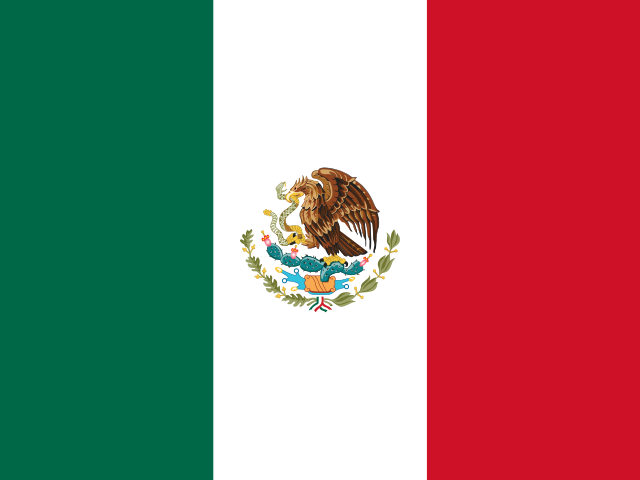
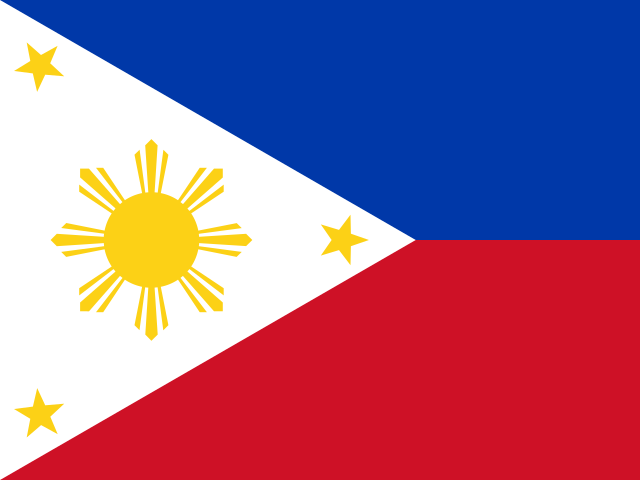
Recent estimates suggest Nevada has approximately 613,800 immigrant residents, including 24,500 immigrant children and 199,100 undocumented immigrants.³¹ Nevada colleges and universities enrolled 2,075 international students, supporting 524 jobs and contributing $63.7 million to the state economy.³² Mexico remains the largest country of origin, accounting for 34.7% of Nevada immigrants, followed by the Philippines at 14.9%, El Salvador at 5.4%, Cuba at 4.1%, and China at 3.4%.³³ Nevada has approximately 18,800 DACA-eligible residents, with an employment rate of 93.8%.³⁴ Collectively, Nevada’s immigrant households have contributed $1.8 billion to local and state taxes.³⁵
References
- City of Las Vegas, Timeline, https://www.lasvegasnevada.gov/Residents/History/Timeline
- Matthew Adam Henderson, Las Vegas, Nevada, in Encyclopedia of Immigration and Migration in the American West 3, Gordon Morris Bakken & Alexandra Kindell eds., 2007.
- Id.
- Id.
- Id. at 4.
- Id.
- Id. and City of Las Vegas, supra note 1.
- Thomas C. Wright, John P. Tuman & Maryam T. Stevenson, Immigration and Ethnic Diversity in Nevada, in The Social Health of Nevada: Leading Indicators and Quality of Life in the Silver State 3, Dmitri N. Shalin ed., 2012.
- Id.
- Britannica Editors, Comstock Lode, Encyclopaedia Britannica, https://www.britannica.com/place/Comstock-Lode
- Thomas C. Wright, John P. Tuman & Maryam T. Stevenson, supra note 8.
- DJ, Nikkei in Nevada, Las Vegas-Clark County Library District, Apr. 2, 2025, https://thelibrarydistrict.org/blogs/post/nikkei-in-nevada/
- Id.
- Id.
- Matthew Adam Henderson, supra note 2.
- NAACP Las Vegas Branch, Fighting for Jobs on the Hoover Dam (1930s), https://www.naacplasvegas.org/history-1111/fighting-for-jobs-on-hoover-dam
- PBS, African Americans and Hoover Dam, American Experience, https://www.pbs.org/wgbh/americanexperience/features/hoover-african-americans/
- NAACP Las Vegas Branch, supra note 16.
- Amy Alonzo, How Hoover Dam Hiring Discrimination Set Back Growth of Nevada’s Black Community, The Nevada Independent, Feb. 26, 2024.
- Matthew Adam Henderson, supra note 2.
- Id.
- Claytee D. White, Historic Black Vegas | Las Vegas’ African-American Timeline: 1941–1960, Las Vegas Black Image Magazine, Jan. 17, 2023, https://lasvegasblackimage.com/2023/01/historic-black-vegas-las-vegas-african-american-timeline-1941-1960/
- U.S. Census Bureau, About the Foreign-Born Population, https://www.census.gov/topics/population/foreign-born/about.html
- Tiffiany Howard & Roman Lewis, Immigration and Ethnic Diversity in Nevada, in The Social Health of Nevada: Leading Indicators and Quality of Life in the Silver State 1–27, Dmitri N. Shalin ed., UNLV Center for Democratic Culture, 2017.
- Id.
- Id.
- Lisa Hirsch, New Jewish Exodus Leads to City of Sin, Los Angeles Times, May 13, 2003, https://www.latimes.com/archives/la-xpm-2003-may-13-et-hirsch13-story.html
- Tiffiany Howard & Roman Lewis, supra note 24.
- Id.
- U.S. Census Bureau, QuickFacts: Las Vegas City, Nevada, https://www.census.gov/quickfacts/fact/table/lasvegascitynevada/PST045224
- American Immigration Council, New Americans in Nevada 1–10, 2025, https://map.americanimmigrationcouncil.org/locations/nevada/
- Id.
- Id.
- Id.
- Id.
Recent Posts



Check Your Eligibility or Ask a Question